
The Harsh Reality of Small Business Stagnation.
You launched your business with a vision of freedom, growth, and impact. Yet years later, you find yourself working longer hours than ever, unable to step away without everything grinding to a halt. You're making money, but you're exhausted. You don't own a business—you own the highest-stress job you've ever had. You're not alone. Data reveals that approximately 80% of small business owners remain trapped in what we at One2Nine Consulting call the "Owner-Dependency Cycle." This isn't a motivational problem or a funding gap—it's a structural failure that prevents scaling, erodes value, and burns out founders.
This comprehensive guide breaks down the three systemic shifts that separate stagnant small businesses from scalable enterprises, backed by real-world data, actionable frameworks, and links to essential tools that can transform your operations within 90 days.
The Diagnosis—Understanding the 80% Trap
What the Data Reveals About Small Business Scaling.
Recent analysis of SME operational patterns across South Africa and global benchmarks from the OECD SME Outlook 2023 shows a consistent pattern:
- 72% of businesses with 5-50 employees show no meaningful growth after year 3
- 68% rely entirely on undocumented, tribal knowledge for core processes
- Only 22% have implemented systematic delegation frameworks
- Businesses with documented systems grow 30% faster and command 2-3× higher valuation multiples
The Cost of Staying Stagnant
The 80% Trap isn't just about missed opportunities—it has measurable financial consequences:
Operational Leakage: 15-25% of revenue lost through inefficiencies
The Three Structural Shifts That Create Scale
Shift 1: From Tribal Knowledge → Systemized Playbooks
The Problem: Your Business Lives in Your Head
When only you know how to handle key clients, troubleshoot your CRM, or manage critical workflows, you've created a single point of failure. This isn't job security—it's a growth ceiling.
The Solution: The Four-Layer Playbook Architecture
We help clients implement this scalable framework:
Process Maps (Visual workflows using Miro or Lucidchart)
Decision Trees (If/Then scenarios for common situations)
Templates & Checklists (Standardized documents in Notion or ClickUp)
Quality Gates (Approval points with clear criteria)
A client in the manufacturing sector was experiencing 12% defect rates in production. The quality process existed only in the owner's experience. We implemented:
- Visual inspection checklists
- Digital quality gates using Google Forms
- Weekly review protocols
Within 60 days, the defect rate dropped to 3%, training time for new quality staff reduced by 70%, and customer returns decreased by 40%.
Shift 2: From Lagging Financials → Leading Activity Indicator
The Measurement Fallacy
Find Your One Big Number
| Business Type | One Big Number | Leading Indicator 1 | Leading Indicator 2 |
|---|---|---|---|
| Service Business | Project Margin % | Proposal → Close Rate | Client Health Score |
| E-commerce | Customer Lifetime Value | Cart Abandonment Rate | Repeat Purchase Rate |
| B2B SaaS | Net Revenue Retention | Feature Adoption Rate | Support Resolution Time |
Implementation Tools
Build dashboards with Google Data Studio
Track metrics in Power BI
Set up automated reports with Zapier
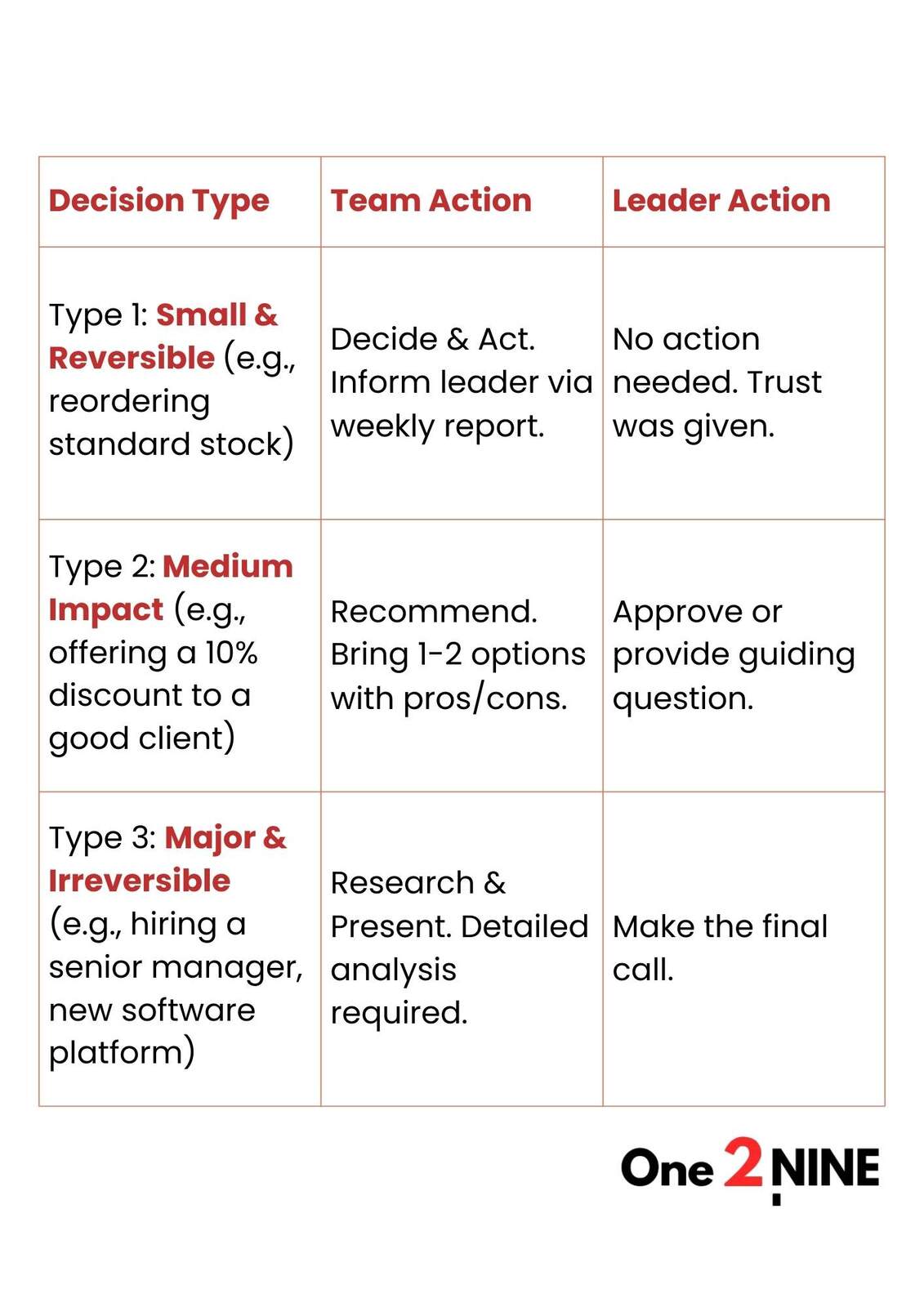
Shift 3: From Centralized Decisions to Distributed Authority
- Team autonomy on reversible, low-risk decisions
- Example: Reordering standard inventory, scheduling routine maintenance
- Team proposes, leader approves medium-impact decisions
- Example: Offering discounts up to 15%, approving standard vendor contracts
- Leader makes irreversible, high-impact decisions with team input
- Example: Hiring senior staff, entering new markets, major capital expenditure
- Tier 1 autonomy for routine updates
- Clear communication protocols
- Weekly review instead of daily approval
Results: Founder regained 15 hours weekly, client satisfaction scores increased by 22%, and team morale improved significantly.
The 90-Day Escape Plan—Your Implementation Roadmap
Weeks 1-4—Document One Critical Process
- Action: Choose the process causing the most daily friction. Document it using this template: Process Documentation Template.
- Success Metric: Another person can execute it at 80% efficacy without your involvement.
- Tool Stack: Loom for screen recordings, Notion for documentation, Tango for workflow capture.
- Action: Identify your One Big Number and two supporting leading indicators.
- Success Metric: Weekly leadership meetings focus on these indicators, not just financial outcomes.
- Tool Stack: Google Sheets for tracking, Geckoboard for dashboards, SimpleKPI for monitoring.
The Economic Impact—ROI of Systematic Scaling
| Investmentnvestment | Time to ROI | Average Impact | Annual Value |
|---|---|---|---|
| Process Documentation | 30-60 days | 15-25% efficiency gain | R150k-R600k |
| Metric Alignment | 60-90 days | 20-30% better forecasting | Reduced cash flow variance by 40% |
| Delegation Framework | 90-120 days | 25-35% leadership capacity freed | Equivalent to R300k-R500k in executive time |
Valuation Multiplier Effect
Common Barriers and Evidence-Based Solutions
Barrier 1:"I'm Too Busy Working IN the Business"
Solution: Time blocking—successful implementers dedicate 90 minutes weekly to system building. Use Clockify to track where your time actually goes.
Barrier 2:Perfection Paralysis
Solution: Progressive documentation—start with voice memos (Otter.ai), move to checklists, then full playbooks. Done is better than perfect.
Barrier 3:Trust Deficit
Solution: Start with low-risk decisions, document outcomes, and expand autonomy based on results. Read The 5 Dysfunctions of a Team for team trust building.
Barrier 4: Metric Confusion
Solution: Test different indicators for 30-day sprints. Use our Metric Testing Framework to find what actually predicts your revenue.
Your Business Awaits Its Architect
- Diagnostic Efficiency Audits - Identify exactly where your growth is leaking
- Operational Velocity Accelerators - Implement the frameworks outlined above
- Executive Strategy Retainers - Ongoing guidance as you scale
- The E-Myth Revisited by Michael Gerber - The classic on working ON your business
- Traction by Gino Wickman —Implementation methodology for scaling methodology for scaling methodology for scaling methodology for scaling- Implementation methodology for scaling- Implementation methodology for scaling- Implementation methodology for scaling- Implementation methodology for scaling
- Scaling Up by Verne Harnish —Strategic frameworks for growth frameworks for growth frameworks for growth- Strategic frameworks for growth- Strategic frameworks for growth- Strategic frameworks for growth- Strategic frameworks for growth- Strategic frameworks for growth

About the Author: Thamsanqa Prince Mchunu is the Founder & Lead Consultant at One2Nine Consulting, a Johannesburg-based firm specializing in post-ERP/CRM/SaaS deployment optimization for SMEs. With 8+ years in client success and digital transformation, he helps businesses turn operational friction into revenue-securing workflows.